Docs Hosting
The docs site should be hosted as a small static surface that stays separate from the Wavemap app/API deploy lane.
The first infrastructure and deploy slices are live. Hosting capacity exists, and the docs deploy workflow has published and smoked the first static artifact.
Selected Shape
Section titled “Selected Shape”- Public hostname:
docs.wavemap.app. - Build artifact:
apps/wavemap-docs/dist. - Runtime model: static files only.
- App runtime dependencies: none.
- Database dependencies: none.
- Wake path dependencies: none.
- Container host dependencies: none.
The docs site should be able to publish content updates without redeploying the frontend, backend, database, runtime host, or deployed-dev control plane.
The first reviewed generated topology figure for this lane is published as a curated docs asset. The paired Mermaid source is kept beside the rendered figure so the reviewed diagram remains inspectable without exposing private generated artifacts.
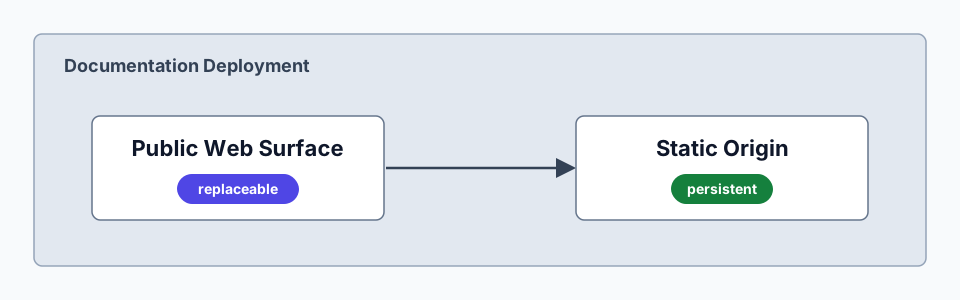
Documentation deployment topology generated from reviewed semantic topology data. Reviewed Mermaid source: fig-docs-site-documentation-deployment.mmd.
Infrastructure Boundary
Section titled “Infrastructure Boundary”The first implementation uses Pulumi-managed AWS resources:
| Concern | Shape |
|---|---|
| Origin storage | Private S3 bucket containing the built docs artifact. |
| CDN | CloudFront distribution in front of the bucket. |
| Origin access | CloudFront origin access control, keeping the bucket private. |
| Certificate | ACM certificate for docs.wavemap.app, issued in us-east-1 for CloudFront. |
| DNS | Delegated Route53 hosted zone for docs.wavemap.app, with A / AAAA aliases to CloudFront. |
| Error handling | Static-site fallback behavior that preserves useful 404s from Starlight. |
The docs hosting resources should be modeled as a separate deployable surface. They may live in the existing Pulumi project, but their purpose, outputs, and deploy permissions should remain distinct from app/API runtime deployment.
The root wavemap.app DNS provider delegates docs.wavemap.app to the Route53 hosted-zone nameservers created by
Pulumi. Without that NS delegation, ACM DNS validation and public docs resolution cannot complete.
DNS Delegation Handoff
Section titled “DNS Delegation Handoff”The first live apply had one external handoff:
- Pulumi creates the
docs.wavemap.apphosted zone. - The generated hosted-zone nameservers are added as
NSrecords fordocs.wavemap.appat the root DNS provider. - ACM DNS validation can complete.
- CloudFront and the public docs alias records can finish provisioning.
If the apply is split, create the hosted zone first, delegate the NS records at the root provider, then apply the certificate, CloudFront distribution, and alias records.
Root DNS delegation remains a manual approval-gated action outside this repo. Exact nameservers and provider readback belong in current infrastructure outputs or private operator evidence rather than this learning page.
Current Status
Section titled “Current Status”The hosting graph, docs-specific GitHub OIDC role, static artifact publication, and public read-only smoke are live. The
curated site is served at https://docs.wavemap.app. Exact resource identifiers and first-rollout run history remain in
private evidence and working notes; the durable contract is the static architecture and permission boundary below.
Deploy Workflow Boundary
Section titled “Deploy Workflow Boundary”The repo-side docs deploy workflow is .github/workflows/deploy-docs.yml. It stays smaller than the deployed-dev app
workflow:
For publish and smoke command contracts, wrapper paths, key flags, and default mutation posture, use the Deploy Docs and Smoke sections of the CLI command reference.
- Check out the selected ref.
- Install dependencies with the shared Node/pnpm setup.
- Assume the docs deploy role through GitHub OIDC.
- Read the current sanitized deployment contract from the private deployment contract store.
- Validate the docs target fields from that contract.
- Build with
pnpm build:docs. - Upload only
apps/wavemap-docs/distto the docs bucket. - Delete removed files from the bucket during sync.
- Create a CloudFront invalidation when published files change.
- Smoke the public docs URL and a small set of critical static assets.
The workflow supports only workflow_dispatch. A human selects the ref to publish after repository review; neither a
pull request nor a develop push publishes automatically. Working-note changes are therefore inert until intentionally
graduated into curated source and selected for a docs deployment.
Future workflow dispatches, permission changes, infrastructure changes, DNS changes, certificate changes, and OIDC trust changes remain approval-gated actions.
Permission Boundary
Section titled “Permission Boundary”Docs deploy permissions use a docs-specific GitHub OIDC role instead of reusing the app/API deploy role. The workflow
expects a GitHub dev environment secret named DOCS_AWS_ROLE_TO_ASSUME, plus environment variables for the deployment
contract stack selector and private artifact bucket. Manual docs publication does not require a Pulumi access token.
Current docs deploy environment values:
- Secret:
DOCS_AWS_ROLE_TO_ASSUME. - Variable:
PULUMI_STACK, required valueaws-dev. - Variable:
DEPLOYMENT_CONTRACT_STORE_BUCKET, resolved from the current protected environment. - Optional variable:
DEPLOYMENT_CONTRACT_STORE_KEY_PREFIX, defaulting todeployment-contracts.
The live role, trust subject, and policy names are deployment outputs rather than documentation constants. Read them from the protected environment and current infrastructure outputs when operating or reviewing the lane.
The deploy role should be limited to:
- Listing the docs bucket.
- Putting and deleting objects under the docs bucket.
- Creating CloudFront invalidations for the docs distribution.
- Reading invalidation status only if the workflow waits for completion.
- Reading the current deployment contract artifacts under the private deployment contract store prefix.
The deploy role should not be able to mutate app/API infrastructure, EC2 runtime state, database resources, SSM runtime parameters, media buckets, ECR repositories, deployment contract artifacts, Route53 records, or ACM certificates.
Pulumi infrastructure changes, DNS changes, certificate creation, OIDC trust changes, and first workflow deploy runs remain explicit approval-gated actions.
Use Cloud Automation Permission Review before broadening the docs deploy role, reusing another deploy role, or adding new docs publish actions.
Publish Boundary
Section titled “Publish Boundary”Only curated site output should enter the public docs bucket.
- Publish
apps/wavemap-docs/dist. - Do not publish
apps/wavemap-docs/working-notes. - Do not publish raw Pulumi exports, raw AWS inventory, workflow evidence, topology snapshots, or local operator notes.
- Publish generated diagrams, summaries, or inventories only after they are reviewed and sanitized into curated docs content or static assets.
The Pagefind search index is acceptable because it is generated from curated docs content.
Smoke Boundary
Section titled “Smoke Boundary”The first smoke check should prove that the static site is reachable and that generated assets load:
https://docs.wavemap.app/https://docs.wavemap.app/developer/architecture/authentication-and-authorization/- The generated search/index assets used by Starlight.
- At least one hashed static asset referenced by the HTML.
Smoke should be read-only. It should not call app/API runtime endpoints or wake deployed-dev infrastructure.
Strategic Source Trail
Section titled “Strategic Source Trail”Follow the hosting boundary through these source owners:
.github/workflows/deploy-docs.ymlowns manual selection, protected-environment authority, build, publish, and smoke ordering..github/actions/prepare-docs-deploy-cloud-job/action.ymlowns the typed GitHub-to-cloud handoff.bin/docs-deployowns shell execution and public CLI compatibility.infra/operations/src/docs-deployowns target validation, deployment-contract reads, and publish planning.infra/pulumi/src/providers/awsowns the docs bucket, CloudFront, certificate, DNS, and narrow OIDC role.apps/wavemap-docs/binowns disclosure audit and built-site route/link verification.
Deferred
Section titled “Deferred”- Pull request preview docs.
- Versioned docs.
- Docs release automation.
- Analytics.
- Access-controlled private docs.
- Automated generated topology publishing.
- Redirect compatibility for old local-only docs routes.